


Formative Action
In formative action, teachers make student learning visible and use that information to support students with meaningful next steps in their learning. When teachers and students actively use evidence of student progress to inform their next steps, formative action becomes a powerful driver of learning. This article explains what formative action is, why it matters for learning, how the formative action cycle works, provides examples, and clears up common misconceptions.
What is formative action?
Formative action refers to the purposeful collection of information about students’ learning and learning processes by teachers, which is then used by teachers and students to inform decisions about follow-up action. The key idea is that teaching and learning decisions improve when they are based on evidence of student learning (Black & Wiliam, 2009).
Formative action is closely connected to the formative (or learning) function of assessment. Related terms include formative assessment and formative evaluation(Black & Wiliam, 2009; Gulikers & Baartman, 2017). The term formative action is preferred because it emphasises that it is not merely about gathering information, but about acting on it. It highlights the active role of teachers and students and the importance of deliberate pedagogical choices (Kneyber et al., 2022). Formative action is therefore not a single instrument or activity, but a continuous, cyclical process embedded in teaching.
Why formative action matters for learning
In their book about formative action, Kneyber et al. (2022) describe how formative action contributes to three core learning processes:
- Cognitive processes: By explicitly clarifying learning outcomes and success criteria, and by responding to students’ current understanding, teachers foster deeper conceptual understanding. Students gain insight into what quality looks like and how to improve their work.
- Motivational processes: The teacher gains the necessary insight to create success experiences and to effectively support students’ progress, thereby strengthening their confidence in their own abilities. In addition, formative action helps make teaching activities more purposeful and, as a result, more meaningful for students. All of this contributes to motivation.
- Self-regulatory processes: Formative action shows students how learning can be monitored and adjusted. By involving students in analysing their own progress and determining follow-up actions, teachers support the development of self-regulated learning skills.
Through these processes, formative action enhances not only what students learn, but also how they learn.
How to apply formative action
Several authors have described models for formative assessment (e.g., Black & Wiliam, 2009; Kneyber et al., 2022) In this article, we use the cycle described by Gulikers and Baartman (2017), as it clearly highlights the role and actions of the teacher and connects well to peer feedback processes. The formative action cycle consists of five phases.
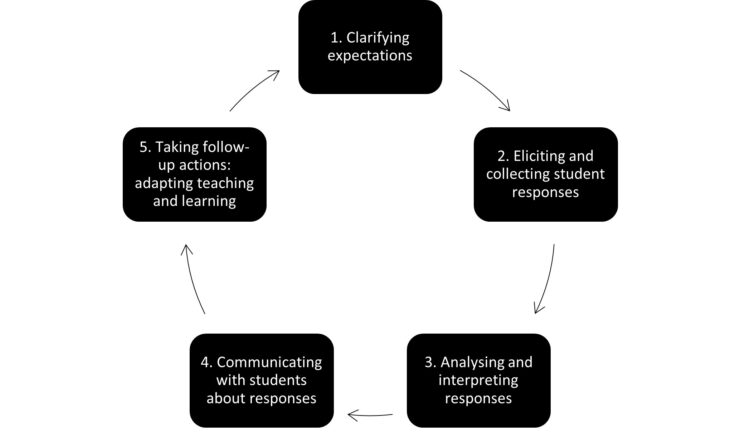
Phase 1: Clarifying expectations
In the first phase, you clarify the learning goals and success criteria for your students. Learning goals describe what students are expected to know or are able to do. Success criteria specify what quality looks like. Teachers can clarify success criteria, whether drawn from their own expertise or from grading tools (e.g., rubrics, answer models), either by themselves or interactively with students. They may also choose to co‑construct success criteria collaboratively with students. A powerful strategy is to use examples of work with varying levels of quality and discuss them together. By analyzing examples, students develop a shared understanding of success criteria and are better able to apply these criteria to their own work.
Phase 2: Eliciting and collecting student reponses
After clarifying the learning goals and success criteria, you design activities that generate meaningful information about student learning in relation to the learning goals. These activities can range from more formal formats, such as draft submissions, practice exams, or structured assignments, to more informal approaches, such as listening to group discussions, observing group work, asking probing questions during class or reviewing mind maps on the spot. The crucial point is alignment: the activities must provide relevant information about the extent to which students are progressing towards the intended learning outcomes.
Phase 3: Analyzing and interpreting responses
The information gathered must be analysed and interpreted. This can be done at the level of individual students, at the group level or based on signals from part of the group. Digital tools (e.g., online quizzes or voting systems) can facilitate quick analysis at group level. It is important to avoid assumptions, such as concluding that students “did not prepare” or “always struggle with this topic.” Instead, explore where the difficulty lies. Is it cognitive, motivational, or self-regulatory? Students can be actively involved in analysing their progress as well as exploring the underlying reasons for any difficulties they encounter.
Phase 4: Communicating with students about responses
In this phase, teachers provide information to students about their learning. Feedback can be directed at individual students, specific groups, or the whole class. The quality of the teacher’s feedback message is crucial and, according to Hattie and Timperley (2007), ideally includes feed up (Where am I going?), feedback (How am I doing?), and feed forward (What is my next step?). In addition to the quality of the feedback message, students’ ability to understand, interpret, and use feedback (student feedback literacy) is essential in this phase.
Phase 5: Taking follow- up actions: adapting teaching and learning
Formative action culminates in action. Feedback alone does not improve learning: it is the use of feedback that makes the difference. Acting on feedback requires follow-up from both students and teachers. Based on the feedback, students may adjust their learning strategies or revise their work, and teachers may adapt their instruction, provide additional explanation, redesign activities, or offer scaffolding. In practice, this phase can be challenging. Students may not receive sufficiently concrete feed forward information, or course designs may not provide opportunities to use feedback in subsequent tasks. Insights from the literature on scaffolding provide further suggestions for meaningful follow-up.
Examples of formative action
Formative action can be applied across different modes of teaching. Below, you will find an example of how the formative action cycle could be applied in a lecture, a tutorial an in thesis supervision.
Lecture
- Clarifying expectations: Briefly state how far students should master a specific lecture topic, for example: “Going forward, you should be able to apply this concept to a specific case”.
- Eliciting and collecting student responses: Ask students to answer a question or solve a problem and indicate their answers using an interactive voting tool or a show of hands.
- Analysing and interpreting responses: Check the results from the voting tool or show of hands. You could ask a few students to explain their answers to get additional information.
- Communicating with students about responses: Explain which answer or solution is correct and why, linking back to the learning goals.
- Taking follow-up actions: If many students struggled, revisit the relevant sections of the lecture or offer suggestions for independent practice afterwards.
Tutorial
- Clarifying expectations: Explain that students need to relate different theories for their final assignment, and clarify what a good synthesis looks like with one or two examples.
- Eliciting and collecting student responses: Ask students to work in groups to create a mind map synthesising this week’s theories, and have each group give a one‑minute pitch.
- Analysing and interpreting responses: Observe groups as they work and review their mind maps and pitches to see what they can already do well and what they still find difficult.
- Communicating with students about responses: After the pitches, give group feedback on strengths and points for improvement in their synthesis.
- Taking follow-up actions: Indicate how students can further practise difficult aspects, and, if time allows, include a short follow‑up activity in a later tutorial.
Thesis supervision
- Clarifying expectations: Review the thesis rubric together and specify what a good thesis introduction looks like.
- Eliciting and collecting student responses: Ask the student to submit a draft introduction before the next supervision meeting.
- Analysing and interpreting responses: Analyse the strengths and areas for improvement in the student’s draft introduction.
- Communicating with students about responses: Provide targeted feedback linked to the rubric criteria via email and/or during the supervision meeting.
- Taking follow-up actions: Ask the student to formulate next steps to improve their introduction, and add your own suggestions, such as studying examples of strong introductions.
Common misconceptions about formative action
In practice, there are still quite a few misunderstandings about formative action (Baartman & Gulikers, 2020), so it is helpful to clarify what it is and what it is not.
- “Formative action takes too much time.” Formative action is often associated with extensive written feedback on drafts or practice exams. However, it can also be integrated into regular teaching through small, deliberate interventions. Teachers can consciously design each phase of the cycle in ways that fit the available time and context.
- “Formative action is a specific tool or activity.” Formative action is not a single instrument. It is the entire cycle of clarifying goals, eliciting evidence, interpreting it, providing feedback, and acting upon the information. The same instrument (e.g., a quiz) can serve different functions. What makes it formative is how the information is used.
- “Formative action equals giving feedback.” Feedback is only one phase of the cycle. Without analysis and follow-up action, feedback alone does not constitute formative action.
- “Formative action is mainly the student’s responsibility.” Although student involvement is essential, the teacher plays a crucial role in all phases of the cycle. Teachers design activities, interpret evidence, structure feedback, and create opportunities for follow-up. At the same time, they can deliberately increase student ownership within this structure.
Formative action is for every teacher
Many teachers already use elements of formative action in their teaching, sometimes without recognizing them as such. By understanding the formative action cycle and its underlying principles, you can make these practices more intentional and coherent. By doing so, you create a learning environment in which students continuously gain insight into their progress and are supported in taking the next step in their development.
Formative action is for every teacher
Many teachers already use elements of formative action in their teaching, sometimes without recognizing them as such. By understanding the formative action cycle and its underlying principles, you can make these practices more intentional and coherent. By doing so, you create a learning environment in which students continuously gain insight into their progress and are supported in taking the next step in their development.
References
- Baartman, L., & Gulikers, J. (2020, February 11). Misconcepties rondom de formatieve toetscyclus in het hbo. Platform Leren van Toetsen. https://lerenvantoetsen.nl/misconcepties-rondom-de-formatieve-toetscyclus-in-het-hbo/
- Black, P., & Wiliam, D. (2009). Developing the theory of formative assessment. Educational Assessment, Evaluation and Accountability, 21(1), 5–31. https://doi.org/10.1007/s11092-008-9068-5
- Gulikers, J. T. M., & Baartman, L. K. J. (2017). Doelgericht professionaliseren: Formatieve toetspraktijken met effect! Wat DOET de docent in de klas? (Eindrapport NRO-PPO overzichtsstudie; dossiernummer 405-15-722). Nationaal Regieorgaan Onderwijsonderzoek (NRO). https://www.nko.nl/sites/nro/files/migrate/Inhoudelijke-eindrapport_NRO-PPO-405-15-722_DEF.pdf
- Hattie, J., & Timperley, H. (2007). The power of feedback. Review of Educational Research, 77(1), 81–112. https://doi.org/10.3102/003465430298487
- Kneyber, R., Sluijsmans, D., Devid, V., & Wilde López, B. (2022). Formatief handelen: Van instrument naar ontwerp. Phronese. https://toetsrevolutie.nl/wp-content/uploads/2022/03/Rene-Kneyber-Formatief-handelen-WEB.pdf